

The Enrollment Problem Nobody Has Fixed
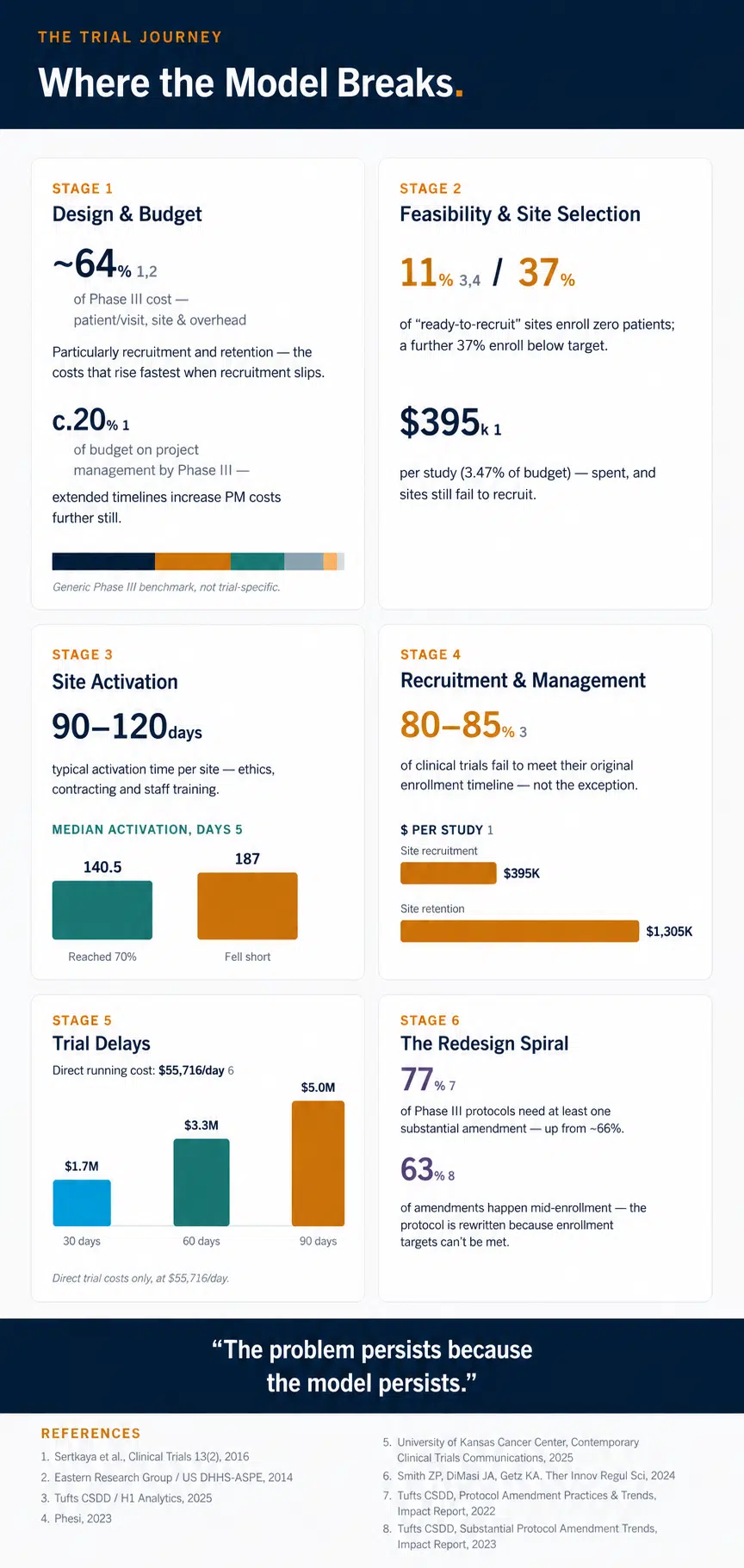
Why do 80–85% of clinical trials still miss their original enrollment timelines?
Despite advances in technology and decentralized delivery models, the industry’s default recruitment model continues to produce the same outcomes. This article explores why—and asks whether it’s time to rethink trial design before studies fall behind.
Key Takeaways
- 80–85% of clinical trials miss their original enrollment timeline, suggesting a systemic issue rather than isolated failures.
- Traditional site selection relies on familiar investigator networks, yet many ‘ready-to-recruit’ sites underperform or recruit no patients at all.
- Adding rescue sites often repeats the same process, increasing costs by millions and delaying timelines by months.
- Decentralized and hybrid approaches can reach patients without lengthy site activation cycles.
- No single delivery model fits every trial, but today’s tools warrant earlier consideration during protocol design.
- Rescue studies demonstrate that flexibility works under pressure—so why wait until a study is already failing?
The Challenge
For years, 80–85% of clinical trials have failed to meet their planned enrollment timelines. This consistency suggests the issue lies with the operating model rather than individual studies.
Where the Model Breaks Down
Protocols, budgets and site selection are established using familiar processes and existing investigator networks. Yet many selected sites never recruit or recruit below expectations, while activating replacement sites adds further delay.
Why Rescue Strategies Fall Short
When recruitment lags, sponsors typically add more sites. Although understandable, this approach repeats the same assumptions, resulting in additional cost, longer activation periods and little opportunity to change outcomes.
A Different Way to Think
Decentralized and hybrid models offer the ability to bring research closer to patients through home visits, community locations and flexible delivery. These approaches can expand access without depending solely on new site activation.
A Balanced Perspective
This is not an argument that decentralized trials are always the answer. Every study requires the right balance of site-based and decentralized delivery. The key question is whether flexibility should be considered proactively instead of only as a rescue measure.
Conclusion
Rescue studies provide a real-world demonstration that alternative delivery models can work when conventional recruitment struggles. Rather than treating this flexibility as a last resort, sponsors should consider making it part of trial design from the outset.
“The problem persists because the model persists.”