

Parkinson’s disease is now the fastest-growing neurological disorder in the world. More than ten million people live with it globally, and that number is rising (Dorsey & Bloem, 2018). Yet for all the scientific progress being made – new targets, new mechanisms, new hope – the trials designed to test those advances are routinely struggling. Recruitment misses timelines. Patients drop out. Studies that looked good on paper run into serious operational trouble long before the data are clean.
This is not a scientific failure. It is an execution failure – and it is largely predictable. Understanding why Parkinson’s trials are hard, and what the evidence tells us works, matters for everyone with a stake in getting new treatments to patients faster.
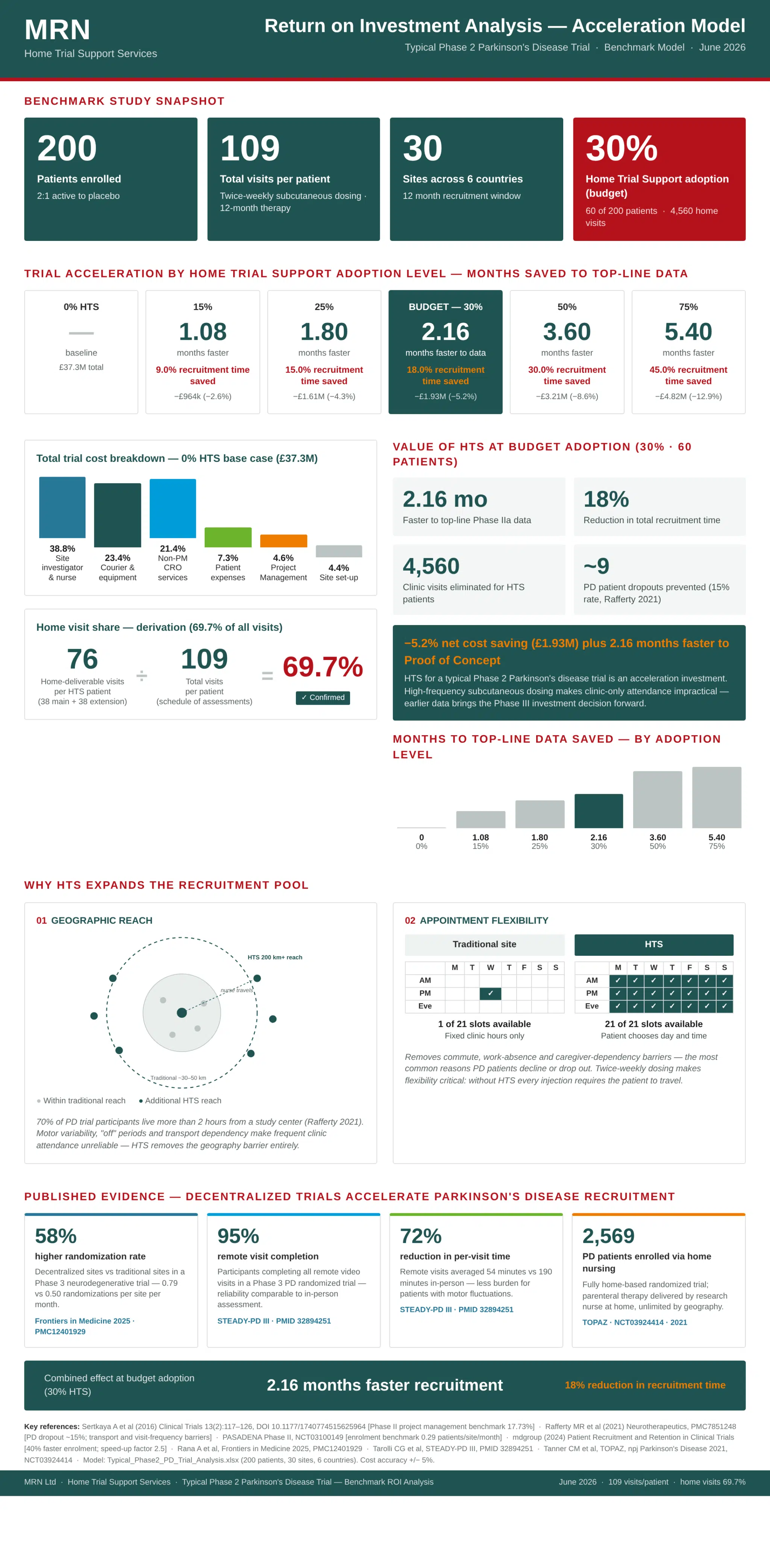
Download the full report by Dr Graham Wylie here. The article draws on a return on investment model we built against a typical Phase IIa Parkinson’s disease trial with twice-weekly subcutaneous injections. The full analysis – including the numbers at each level of Home Trial Support adoption – is set out in the infographic which is shown below and can be downloaded here.